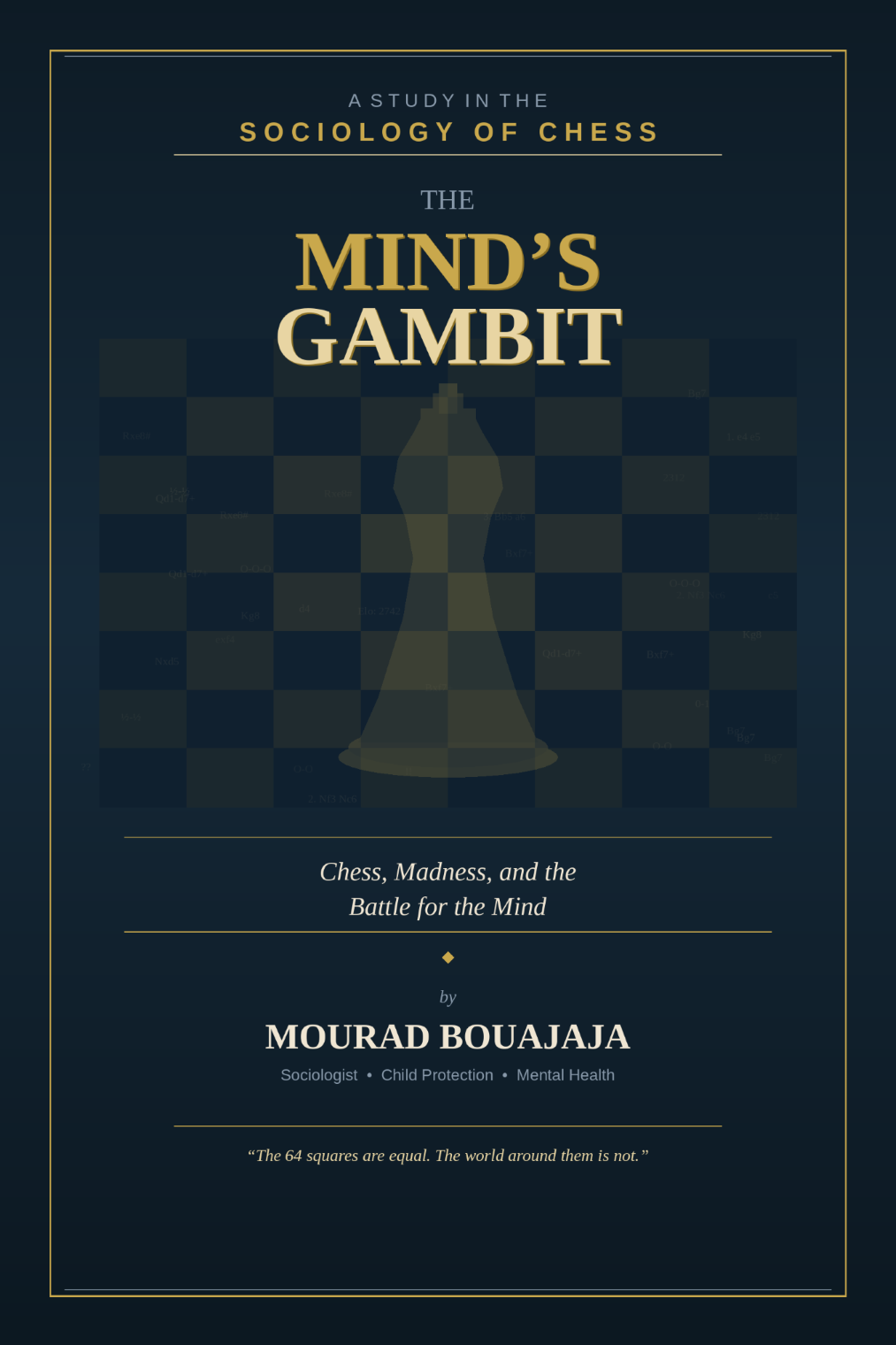
In competitive chess, your identity is a number. Your Elo rating follows you everywhere—it signals, to anyone who cares to look, exactly where you stand. This article examines how a statistical tool designed for neutral measurement became one of the most powerful psychological forces in the game, and what that tells us about the systems we build to measure human worth.
“Chess is the School of Life. A Man Learns Much There of Himself and of Others.” — Vasily Smyslov
The Quantitative Mirror
When I think of competitive chess today—whether I’m in a tournament hall or sitting alone in the dimly lit blue glow of my living room—I see a quantification-based institution. That same 1500-year-old game I played with men in Megrine has evolved into a rigid, quantifiable “technology of the self” that transforms us all as we interact with it.
This chapter represents a critical examination of the Elo rating system—which is more than just a mathematical equation—as a “classification system” that changes the social reality of anyone who interacts with it. Utilizing the method of autoethnography, I will demonstrate that the four-digit number next to your name is more than a measurement. It is a technology of identity.
The Cultural Shift: Megrine vs. Manhattan
My understanding of this “technology” emerged from a huge cultural shift. In the late 1970’s, my socialization occurred at “Uncle Mohamed’s” coffee shop in Megrine, Tunisia. In “Uncle Mohamed’s”, respect was not a measurable, tangible quality; it was a visceral, experiential quality. Respect was earned through your physical presence, the weight of your words, and your age. When the elder men debated politics while placing dominoes, their social status reflected their history within the community. You were a person first, and a player second.
In contrast, when I arrived in New York City, I assumed a similar social contract existed. I went to the community of Stuyvesant Town in Manhattan, and after some time, I found my way to the stone tables along First Avenue. Before I could even say hello or sit down, I was greeted with a question that felt like a border crossing:
“What is your rating?”
At the time, I was not affiliated with the United States Chess Federation, therefore I did not have a rating. Therefore, to the Manhattan players, not having a rating indicated that I was an unknown quantity. I was invisible to their social hierarchy. While I sat at the tables, I noticed the air was thick with no political debates, but with “weird comparisons of Elo,” that seemed ridiculous to my sociological ears. The players were sharing their ratings like they were deeds to property and were competing in a tallying of worth that was both unfamiliar to me and frightening. Without a rating, I felt exposed. The Number didn’t indicate how skilled of a player I was; it indicated the cost of entry to the community.
The Wall and the Verdict: Pittsburgh
Whereas Manhattan illustrated to me the social significance of the rating, my initial visit to the Pittsburgh Chess Club demonstrated to me the institutional significance of the rating. I specifically recall paying a $35 registration fee—literally the price of admission to the quantified social hierarchy.
Approximately thirty minutes later, the Tournament Director came to the wall and published the pairing sheet. The “wall” is the ultimate sociological site in chess. This is the location where the institution delivers its final decision. I walked up to the wall, and I saw my name: I was to play black versus a player rated 2200—a master.
My response was immediate and physiological. I felt a wave of fear and anxiety unlike anything I had experienced in Megrine. In the coffeehouse, I was simply playing another man; in the chess club, I was playing “2200”. The Number predated the individual and startled me. By the time I sat at the board, I had already lost. I was so debilitated by anxiety generated by my rating that I “gave up”—I dropped out quickly, not due to a lack of ability, but due to all the available cognitive resources I had to utilize to contend with the anxiety generated by my rating.
I did not complete the tournament. I drove back home in a deep sense of disappointment—a classic manifestation of “learned helplessness” (Seligman & Maier, 1967). I told myself, “I will never play chess again.” The institutional verdict, rendered via the wall, determined that effort would be futile against the Number.
The Digital Obsession: The Domestic Trap
However, the Number does not relinquish its hold easily. The “never again” of that ride home from Pittsburgh ultimately transformed into a new type of fixation—one shaped by the digital age.
For numerous nights, I engage in a similar pattern of behavior. At 2:00 AM, in total darkness, I sit at a computer screen staring at it. My wife is asleep upstairs, and her presence serves as a quiet reminder of the “social isolation” I established for myself. I informed her hours prior that I would “play just one or two games.” At that point, I was truthful; however, as the night continued, remorse for that deception began to develop.
Remorse did not lead to sleep; it led to panic. In the heavy silence of the house, I felt pressured to win the subsequent game to validate the hours I stole from my life and from her. If I won, I could convince myself that the hours spent playing were valuable. If I lost, I would find myself trapped in a vicious cycle of “learned helplessness,” believing that I had to rapidly improve since losing was no longer an option.
The desire to rectify the Number caused me to obsessively consume: YouTube spirals, a large collection of unread books, expensive software like Chess Base, and a high-end digital board. I also hired a Ukrainian Woman Grandmaster to virtually analyze my failures with me every Saturday morning. I improved, but at the expense of the intellectual essence of the game I once cherished in Megrine.
I look at the “theory library” Slim Bouaziz once gave me—the books intended to serve as tools for liberation and mastery of the game—and I feel the Number has sucked the soul right out of them. They are no longer vessels of strategic wisdom or beauty; they are simply optimization manuals for a four-digit number. I greatly miss those days in Megrine when a game was a conversation, and respect that was a shared human experience long before everything became quantitatively defined into a cold, unforgiving metric.
The Sociologist’s Double Identity
As an independent scholar, I frequently occupy dual identity during these experiences. I am the player experiencing the “tilt”—the cognitive dysregulation resulting from a losing streak—and I am the observer studying the experience.
During a particularly grueling late-night downward spiral, I suddenly ceased playing. I was losing terribly, my rating was dropping precipitously, and I was panicking. During that moment, a sociological “aha!” flashed through my mind: I was then a living embodiment of the Matthew Effect. I was witnessing the erosion of my carefully constructed competitive capital in real-time, and the institution was making it increasingly difficult for me to recover.
At other times, I observe Goffman’s “performance of the self” in operation. I realize that I am not merely playing chess; I am frantically attempting to maintain the illusion of intellectual competence that the Number is actively destroying. This awareness does not alleviate the discomfort of losing; however, it aids in identifying the source of the distress: the distress is not in the game; it is in the classification.
The Performance of the Self: The Million Excuses
This tenuous identity exists in every chess community. As Goffman (1959) noted, we perform for an audience. I remember a specific instance at the Manhattan tables in which a highly rated player lost to a young boy. Immediately following the loss, the man began to provide a multitude of “absurd” excuses—the sun, his tiredness, his lack of focus. He was not defending his performance; he was protecting his “face.” The other players ridiculed the obviousness of his desperation. His rating had ensured him a status that the board had recently revoked, and he was left with nothing but his explanations.
Title to Fetishism: A Brief History of the Bell Curve
Before the 1960’s, chess status was based upon titles—Master, Candidate Master, Expert. In 1961, Arpad Elo attempted to eliminate the subjectivity of chess status through the use of the “normal distribution”—the bell curve (Elo 1978).
Arpad Elo warned against “rating fetishism”—the false assumption that a rating could quantify a player’s inherent worth. The chess community ignored him. The simplicity of the rating system was too appealing. It provided a definitive answer to the question: How good am I?
Metrics of Self: A Theoretical Framework
To understand how a number becomes a person, we study how metrics affect the world they measure. Wendy Nelson Espeland and Michael Sauder (2007) demonstrate that when we rank institutions, they cease to concern themselves with their purpose and instead become concerned with the ranking. This is what has occurred with the chess player.
The Elo rating system incorporates value statements: that strength can be quantified and that higher ratings translate to greater social standing. These create “cultural capital” (Bourdieu, 1984). The rating has developed into a credential, one that is often considered more significant than the intellectual richness of the game itself.
Conclusion: Reclaiming a More Human Chess
The Elo rating system is not “bad” mathematics; it has developed into a bad social institution. To reclaim the intellectual beauty of chess, we must consider how we view these numbers.
As a scholar, I firmly believe that chess organizations have a moral obligation to protect the mental health of their members. We must establish communities—as I remember from Megrine—that emphasize community and presence over the constant, oppressive display of the hierarchy.
Chess should be an activity that demonstrates strategic beauty and resilience. It is our responsibility to ensure “The Number” does not damage the minds it was designed to evaluate.
References: Bourdieu (1984), Distinction · Elo (1978), The Rating of Chessplayers · Espeland & Sauder (2007), Rankings and Reactivity · Goffman (1959), The Presentation of Self in Everyday Life · Seligman & Maier (1967), Failure to Escape Traumatic Shock · Simon & Chase (1973), Skill in Chess